Centennial Airport Land Use Guidelines

The land use guidelines below delineate specific zones around the airport and outline the development recommendations in each. These criteria are utilized by airport staff when reviewing proposed developments in the surrounding area.

Airport Influence Area (AIA) – Refer all plats and development plans to ACPAA for review. Comply with FAR Part 77. Require Avigation Easement by landowner and Public Disclosure to prospective buyers and tenants. Residential and other noise sensitive development requires a 7-day noise test and development is prohibited/not recommended in areas at 65 DNL and above.

Restricted Development Area (RDA) – Prohibit new residential and other noise sensitive development. Building height must comply with FAR Part 77 surface criteria, existing or future, whichever is more restrictive.
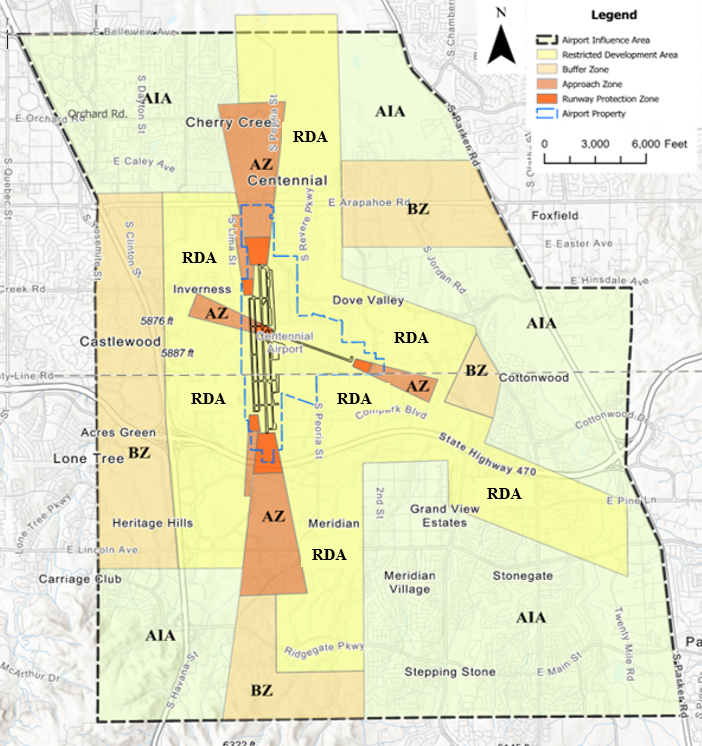
Buffer Zone (BZ) – Recommend no new residential or other noise sensitive development. Governmental entity with zoning and building permit authority to develop specific restrictions.

Approach Zone (AZ) – Prohibit new residential and other noise sensitive development. Building height must comply with FAR Part 77 surface criteria, existing or future, whichever is more restrictive.
Voluntary Noise Abatement

Centennial Airport is committed to being a good neighbor to the surrounding communities while continuing to serve as one of the nation’s busiest general aviation airports. Our Voluntary Noise Abatement Guidelines are designed to help pilots minimize aircraft noise impacts by using recommended procedures and flight paths that balance safety with community consideration.

While these guidelines are not regulatory and do not compromise safety or FAA requirements, they represent best practices developed in collaboration with pilots, air traffic control, and local residents. Federal Law only allows these measures to be voluntary:

“Under the Airport Noise and Capacity Act of 1990 (ANCA), public-use airports may not impose new mandatory noise or access restrictions on certain aircraft without completing an extensive FAA review and approval process.”

As a result, Centennial’s noise abatement measures are voluntary to ensure compliance with federal law while promoting safe and neighborly operations.

Centennial Airport Noise Abatement Communications Plan

Click here to view Centennial Airport’s Noise Abatement Information Communications Plan, which outlines how noise abatement information is distributed and ensures the understanding of noise information to all aircraft operators.

Additional Noise Contacts


Quick Centennial Airport Contacts

Zach Gabehart
Planning Specialist – Noise & Environmental 
Phone: (303) 218-2919

Lauren Wiarda
Director of Planning & Development
Phone: (303) 218-2928


Area Airport Noise Contacts

Denver International Airport (DEN)
Office of Noise Management
DEN Noise Hotline: (303) 342-2380
Symphony PublicVue Online Tracking and Complaint System 

Rocky Mountain Metro Airport (BJC)
Airport Operations Specialist
Phone: (303) 271-4874
RMMA Voluntary Noise Abatement

Buckley Space Force Base (BKF)
Noise complaints should be submitted to the 140th Wing Public Affairs Office
Noise Email: usaf.co.140-wg.mbx.Noise-Comment@mail.mil
Army helicopter complaints: (720) 250-1398 / Air Force Jet/Cargo Aircraft: (720) 847-6164

U.S. Air Force Academy (AFA)
Community Relations Office: PA.COMREL2@usafa.edu.
Noise Complaint Form 

Report Archive

This is the report archive, where you can find the archived reports that we have produced and shared with the community.

2026 Monthly Noise Reports


2025 Monthly Noise Reports


CACNR Noise Study Group Reports


2025 CACNR Minutes


2025 CACNR Minutes

Frequently Asked Questions


Contact the Federal Aviation Administration (FAA)

The Federal Aviation Administration’s (FAA) mission is to ensure the safe and efficient use of our nation’s airspace, unlike that of the airport which is responsible for all things on the ground. Once an aircraft departs Centennial Airport, it enters the national airspace and thus comes under the jurisdiction of the FAA. We’ve gathered some resources from the FAA to make it easier to reach out regarding noise concerns. 

FAA Hotline

These online resources may be used to be used for any general safety inquiries, including reporting any low-flying aircraft concern. If you know the aircraft’s tail number utilize the FAA Hotline.  If you don’t know the aircraft’s tail number, report through the Flight Standards District Office (FSDO) below. 

Denver Flight Standards District Office (FSDO)

To be used to report low-flying aircraft concerns/inquiries without knowing the aircraft’s tail number.

FAA NW Mountain Region Noise Portal

This is part of the FAA’s public outreach program to work with the community regarding aircraft noise concerns. It may be used for noise complaints directly to the FAA.